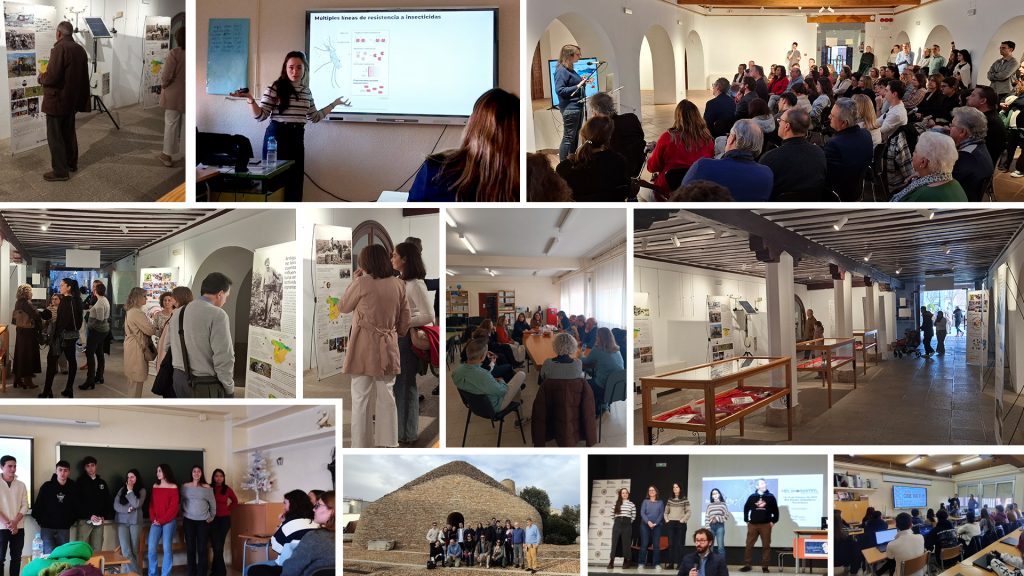
The fourth annual Meet & Fly of Melanogaster Catch The Fly! (MCTF), the international citizen science network on adaptation genomics that brings together scientists, students, and teachers from various Spanish and international schools, concluded its fourth edition last weekend with the opening of the exhibition “Time Flies!: Observing Our History and Relationship with Biodiversity”.
The event took place on February 14–15, 2025, at IES Eladio Cabañero in Tomelloso, hosting schools from Ciudad Real, Valencia, Navarra, and Granada. It served as a space for exchange and reflection on the latest research into the impact of climate change on the genetics and evolution of Drosophila melanogaster.
The program included a wide range of activities exclusively for MCTF participants, such as scientific talks and immersive workshops led by prominent speakers:
“Transposable Elements in Genome Function”
Josefa González, Principal Investigator at the Laboratory of Evolutionary and Functional Genomics (González Lab), Institut Botànic de Barcelona (IBB, CSIC-CMCNB), and co-founder of the European Drosophila Population Genomics Consortium (DrosEU).
Code The Fly: “Immersive Bioinformatics Workshop” (6 hours)
Sònia Casillas, Associate Professor and Researcher at Universitat Autònoma de Barcelona (UAB).
“Combating Mathematical-Statistical Illiteracy”
Raquel Villacampa, Mathematician, Professor, and Researcher at the University of Zaragoza.
“Track The Fly”
- The effect of climate change on biodiversity
- Drosophila as environmental indicators
- Access to public databases on environmental indicators
- Data analysis, visualization, and hypothesis generation
Marta Coronado, Postdoctoral Researcher, González Lab, Institut Botànic de Barcelona (IBB, CSIC-CMCNB).
“Adaptation to Urban Environments in Malaria-Transmitting Mosquitoes”
Marta Coronado, Postdoctoral Researcher, González Lab (IBB, CSIC-CMCNB).
Citizen Fly Lab: “Molecular Biology Activities for Students and Teachers from Germany”
Christian Feller and his students, invited participants from Sankt Afra High School (Meißen, Germany).
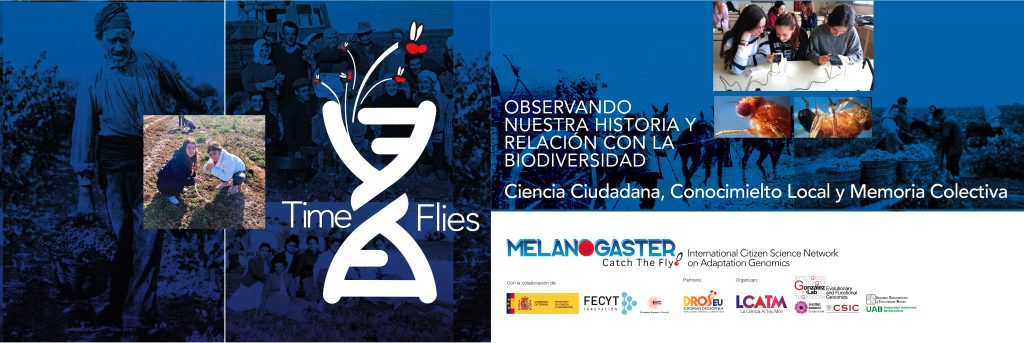
The event concluded on Saturday, February 15, with two public activities held at the Posada de los Portales in Tomelloso. At 6:00 p.m., Josefa González (IBB, CSIC-CMCNB) gave a presentation on collaborative science and the adaptation of organisms to their environment. This was followed at 6:30 p.m. by the opening of the exhibition “Time Flies!: Observing Our History and Relationship with Biodiversity”. The inauguration was attended by the Director of IES Eladio Cabañero, the city mayor Javier Navarro, and the Councillors for Culture and Education, Inés Losa and Antonio Calvo.
“Time Flies!” is a new initiative of the MCTF project that aims to integrate “local knowledge” and the “collective memory” of people working in the field with the efforts of students, teachers, and European scientists, in order to enrich research on the impact of climate change on local and global biodiversity. The goal of this integration is to gain new perspectives and interpretations through the daily work and observations of citizens in rural areas, offering enormous potential to enhance scientific understanding in adaptation genomics.
“I believe that for the students it is an opportunity to get closer to the scientific world. They have interacted with and attended talks by top-level researchers, and I think this brings them much closer to a reality they usually see as very distant.” – José Andrés Casas, teacher at Col·legi Mare de Deu de l’Olivar II, Valencia
“This program has been very interesting for us as students; it has been enriching and we have learned a lot about science (…) and it has also helped us appreciate what we have in our region, based on the research we carried out on agriculture.” – Student, IES Benjamín de Tudela
The Meet & Fly! activities and the “Time Flies!” exhibition in Tomelloso are part of the citizen science project Melanogaster Catch The Fly! (MCTF), organized by the Laboraboratory of Evolutionary and Functional Genomics at the Institut Botànic de Barcelona (CSIC – CMCNB), the science outreach platform La Ciència Al Teu Món (LCATM), and the Universitat Autònoma de Barcelona (UAB). MCTF is supported by the Spanish Foundation for Science and Technology – Ministry of Science and Innovation (FECYT), the European Drosophila Population Genomics Consortium (DrosEU), the European Research Council (ERC), IES Eladio Cabañero, the City Council of Tomelloso, and Vinícola de Tomelloso. Participating schools include CES Ramón y Cajal (Granada), IES Benjamín de Tudela, Col·legi Mare de Deu de l’Olivar II (Valencia), IES José de Mora (Baza), and IES Azuer (Manzanares).

